 |
Navigating the Mental Health Internet |
Lesson 1.1 Background |
||
Physically the Internet is composed of a global network of computers that are linked to one another. Some of these computers, designated as servers, store vast amounts of data including text, graphics, audio, and video files that are accessible to anyone hooked to the Internet - usually without cost. The networking of computers is creating a Global Digital Library. Since the 17th century, it has been the dream of Encyclopediasts to compile all knowledge in an easily accessible form. But human knowledge quickly outstripped the capacity of one set of books to contain everything. However, such compilation, organization, and dissemination of all knowledge is now being achieved 200 years later by means of computer networks instead of books. And information is not limited to text documents. Graphic, audio, and video resources are increasingly available on the Internet. The Internet is also a powerful communication tool. E-mail is still the most popular use of the Internet. The Internet's potential as a tool for communicating has been limited by bandwidth considerations, but many expect that within a few years, videoconferencing will be routine. Audio conferencing is quite feasible with today's modems. Ours may turn out to be the "communication age" rather than the "information age." The Internet was initially conceived and developed in the 1960's by the U.S. Department of Defense to create a command-and-control network that would function following a nuclear war. They realized that no network's switches and wiring could be entirely protected from the impact of atomic bombs. The solution was to create a totally decentralized communication network with no central authority or network which could be knocked out. Messages would be sent via any of a number of alternative routes over whatever lines were available at the moment. In his Brief History of the Internet, Bruce Sterling describes this conception in his science fiction style:
The growth of the Internet has outpaced all other forms of mass communication, exceeding that of radio, television, and even the personal computer itself. As of August 2001, an estimated 500 million people are connected to the Internet, with the majority in North America and Western Europe, but there are users in every country on the globe (see Global Internet Statistics). The web has greatly simplified access to information compared with gopher, ftp, and telnet, the earlier information retrieval systems that require knowledge of many arcane commands. The web has an entirely graphical interface, meaning all you need to do to locate, save, and print resources is point and click with a mouse. Originally proposed in 1989, the web did not gain any widespread popular use until Mosaic, the first browser, became available in early 1993. Usage of the web then doubled every 4 months for several years, and is only now slowing because the statistical base has gotten larger. The web is currently driving the development of the Internet. In 1993, there were a mere 130 servers storing web pages. As of August 2001, there are an estimated 150 million web sites with over 2 billion pages indexed by the Google search engine.
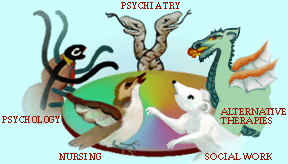
Why Learn To Navigate the Mental Health Internet The Internet is a revolutionary information technology which rivals speech, writing, and books in its potential to transform the exchange of human knowledge. It is having a major impact on training and practice in all of the mental health professions. The portion of the Internet known as the World Wide Web, only in existence since 1993, already contains vast archives of scientific and clinical literature. The entire body of published healthcare and scientific literature is available online in abstract form via PsycINFO, MEDLINE and other important searchable bibliographic databases. In some scientific areas, the Internet has already become the major publication vehicle, entirely supplanting printed journals (e.g., a physics web site called e-Print). The Internet also allows mental health professionals to participate in online case seminars that expand their personal knowledge base and refine their professional skills. Since Hippocrates, health professionals have held interdisciplinary case seminars to disseminate the latest understandings in their fields. Like a case seminar, the Internet is inherently cross-disciplinary. Resources on mental health are found from the perspectives of all health care disciplines (e.g., psychology, medicine, nursing, social work, etc.). The information exchange and communication capacities of the Internet create a global Virtual Case Seminar which provides access to cross-disciplinary resources and colleagues.
Searches on the Internet also cross scientific disciplinary boundaries. An online search on the web for a mental health topic (e.g., anxiety) will return sources from anthropology, religion, the humanities, and biology, which offer valuable perspectives on clinical issues.
While this course is primarily concerned with the Internet's potential to be a resource for mental health professionals, one should not overlook its downsides as well. Anyone can put up a web site about anything. While this can be seen as furthering the decentralization and democratization of access to information, the lack of any quality control also permits the creation of worthless and even misleading web sites. However, there are some counterbalancing trends. Some organizations provide ratings of web sites, for example, the Mental Help Net site, which you will visit several times in the course, performs this service for mental health professionals by rating sites both for content and ease of use. There are also serious issues to consider about the long-term impact of the Internet. As people communicate more and more in cyberspace, do they lose touch with their communities and bioregions? Does spending more and more time in front of a monitor have a deleterious effect on family life (as has been demonstrated with television watching)1. This issue is considered further in the course section on Internet Addiction. Will the Internet promote further disconnection between mind and body as communication is stripped of its visual, kinesthetic, olfactory and other sense components, and people spend more time in physically unchallenging activities? While these issues should be carefully considered and investigated, the Internet is here to stay, is expanding exponentially, and is an important resource for mental health professionals.
Online Learning via the Mental Health Internet Online learning will evolve rapidly over the next 10 years (practically a millennium in Internet time!) to become an indispensable tool in clinical practice. In 1997, the American Psychological Association issued a report on the Education, Training and Continuing Professional Education of Psychologists that highlighted the increasing role that the new computer-based technologies will play in our profession:
The advanced degrees we have earned are not certification of perpetual competence. Mental health professionals need to be constantly engaged in learning activities. The Internet is fast becoming the prevailing infotechnology for learning, especially activities involving information retrieval, processing, creation, and communication. Its usefulness in training psychotherapy skills is still quite limited, but the Internet is a powerful infotechnology tool for staying current with research findings, learning about the development of new clinical approaches, tracking trends in the marketplace that affect the mental health field, and engaging in peer collaboration and supervision. CLOSE THIS WINDOW WHEN DONE WITH LESSON 1
|

 |
 |